

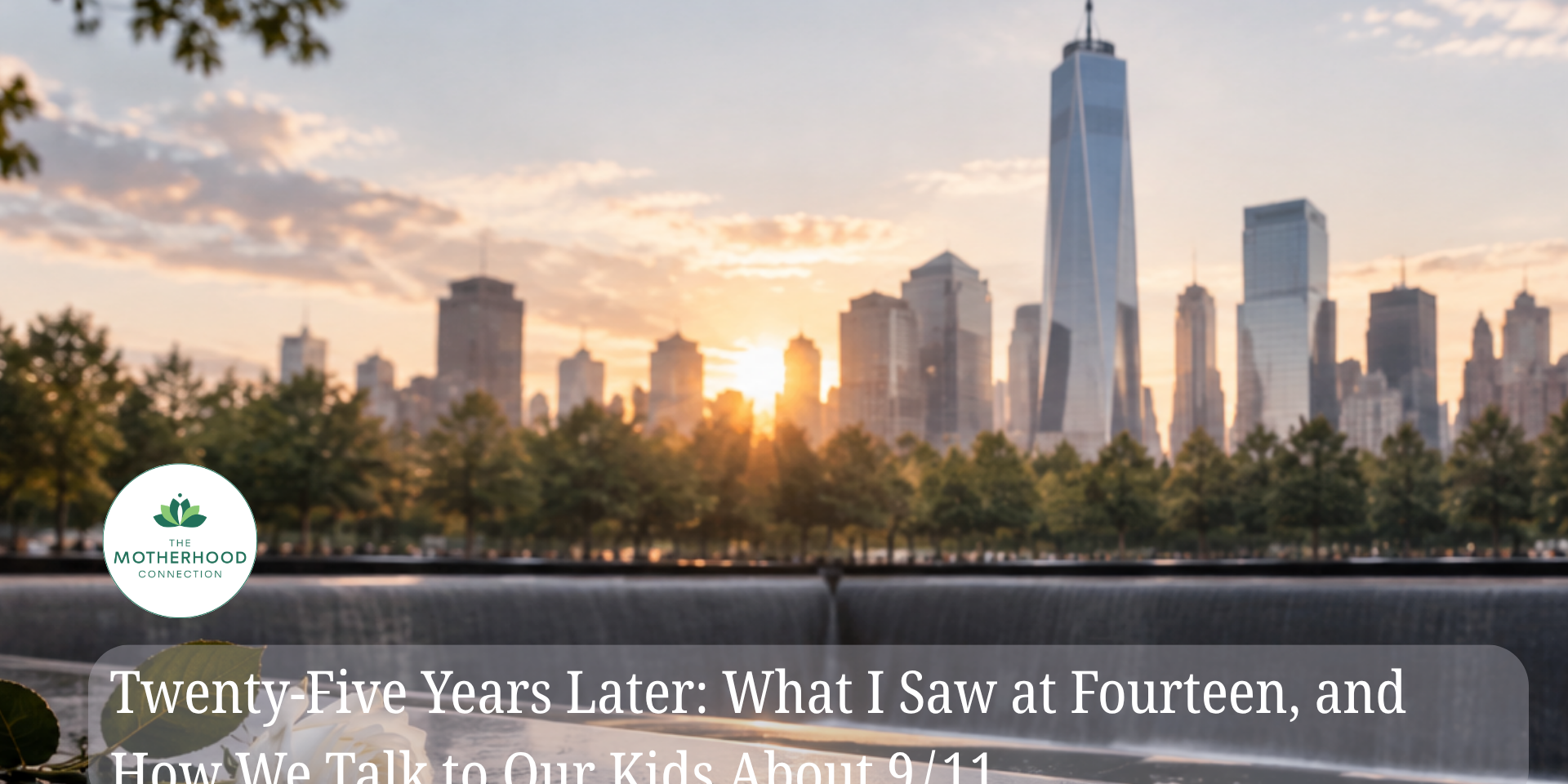
Twenty-Five Years Later: What I Saw at Fourteen, and How We Talk to Our Kids About 9/11
By: Kristin Villareal, a Long Beach Mom
It was a normal day.
That’s the part I most want you to understand.
September 11, 2001 was a Tuesday, and I woke up that morning thinking about my friends, my new school, and probably the boy I had a crush on. There was nothing spectacular about the start of that day. Nothing about it felt like the beginning of anything.
Twenty-five years later, an entire generation is growing up with no memory of it at all. They know the towers from photographs. They know Flight 93 and the Pentagon the way they know Pearl Harbor — as something that happened to other people, in another time, before them.
I live in the greater Long Beach area now. My own children are twenty and twelve, and they are being raised three thousand miles from the Bronx. Neither of them was alive for any of this. But they know how that day felt because I have taken the time to teach them. We talk about it every year, and we remember the lives that were lost.
I was in New York when the towers fell. Not downtown at the towers, but I was a fourteen-year-old girl in the Bronx, sitting in school.
I want to tell you what that Tuesday actually looked like from where I was standing, as a child who had no idea the world was about to change.
One thing is worth knowing first, especially for those of us who now live out here.
Everything I am about to describe happened on an Eastern clock. The first plane struck the North Tower at 8:46 in the morning Eastern time — 5:46 a.m. here in California. The second plane hit at 9:03 Eastern, which was 6:03 our time. The South Tower came down at 9:59 Eastern, 6:59 here. The North Tower fell at 10:28, which was 7:28 in the morning here.
By the time much of Southern California was awake, both towers were already gone.
fourteen years old, a freshman at an all-girls Catholic school. It was only the first few weeks of the school year, and I was sitting in first-period English, where we were watching a movie based on our summer reading book.
I can’t remember what novel we had to read.
What I remember is the room.
All of us were sitting in the dark, focused on the little TV on its rolling cart, completely engrossed in the movie, when the principal’s voice came over the loudspeaker.
A small aircraft had crashed into the World Trade Center.
She assured us that it seemed to be an accident and that the school didn’t have any additional details yet. But there were girls in our school whose parents and loved ones worked or lived near the World Trade Center, so she promised they would keep us updated.
Our teacher turned the lights on.
The movie stayed off.
We began talking quietly among ourselves about what we had just heard.
It wasn’t much longer before the principal came over the loudspeaker again.
Another plane had hit the towers.
It now appeared to be an act of terrorism.
Terrorism.
At fourteen, I didn’t really understand that word. I wasn’t sure what it meant. I only knew that it was bad.
And the bad felt heavy.
That is an enormous concept for an adult to understand, let alone to hand to a freshman in the middle of first period. But it became one of the words that defined our generation, because for those of us who remember that morning, there has always been a before and an after.
When the bell rang, I walked to my second-period class through hallways that had gone silent. The fear in the building was tangible. Girls gathered at their lockers, checking phones and holding onto each other.
As soon as we were in our seats, our teacher led the whole class in prayer.
I had only been there a short time before the front office announced that my family had arrived to pick me up. A few other girls were called out at the same time. As I made my way down the hall, I passed other classrooms where girls were also leaving as their families arrived for them.
When I came down the stairs, my aunt was standing in the entrance with my younger brother.
I asked her what was going on.
She told me she wasn’t sure. Planes had hit the towers. People were saying it was terrorism.
It wasn’t until I got home that the gravity of what was happening truly hit me.
My grandmother was sitting in the living room in front of the television, completely silent, tears running down her face.
I gave her a hug.
Then I sat beside her and watched.
I remember the images of the planes hitting the towers. The smoke billowing out of them. The people on the ground looking up.
And then the most shocking thing of all.
I watched on live television as the first tower crumbled, and I remember praying to God to help the people.
Then the second one came down.
I remember the sadness.
I remember sitting there in silence thinking that this could not possibly be real.
And I remember an overwhelming need to help — to reach out, to lift somebody up, to do something.
I was fourteen years old. I couldn’t do any of those things.
So I did the only thing I knew how to do at that moment.
I prayed. The adults around me prayed too.
I don’t remember which one of us said it first.
Let’s go to church.
It was probably my grandmother. She was a very devout and godly woman.
We put our coats on and walked out the door, turned the corner, and headed up the hill toward our church on the horizon.
As we got closer, I noticed other groups of people walking from every direction toward that same building.
It sat up there like a beacon.
When we arrived, the doors were locked. It was the middle of the week.
My grandmother volunteered there and had a key to the rectory, so she let herself in and found someone who could unlock the church for the people already gathering outside.
Within thirty minutes or so, it had filled.
Some people sat.
Some knelt in prayer.
Others simply cried.
A priest came in after a while and led the congregation in prayer. Eventually he left, and the people stayed exactly where they were.
Still praying.
It was well after dark when we finally left.
None of us wanted to go home. That overwhelming need to do something was still there.
Before we ever reached the house, my aunt had decided what we would do.
We were going to the grocery store.
We would buy as many supplies as we could carry, and we would take them into Manhattan.
She asked my younger brother and me if we wanted to help.
I remember the feeling of absolute certainty.
Of course we did.
We bought water, drinks, and snacks. Then we physically carried all of it onto the subway and rode downtown as far as the trains would take us.
We got off somewhere around 34th Street, as best as I can remember, and walked.
And walked.
I remember that I didn’t complain.
I just kept walking and carrying.
Eventually we reached barricades that stopped us from going any farther.
And then we found a local firehouse.
It was empty.
The doors were unlocked. The rigs were gone. Candles sat outside.
Inside was a table already covered in donations.
Other people had gotten there before us.
We added what we had carried to the pile.
And then we went home.
It was a small act of service — especially small compared with the men and women who rushed into burning buildings to save other people that day.
But it was one of the many countless small acts of service that day, as a city full of strangers found ways to care for one another.
What I Carry
In the weeks that followed, there were symbols of the pain the city and country were feeling everywhere.
American flags on buildings, cars, and people.
Flyers with the faces of missing loved ones plastered on the walls.
Candlelight vigils outside fire stations.
Those images are strong.
But they aren’t the ones I carry most.
The things I carry are much closer to home.
One of my classmates had a mother who was a paramedic working at Ground Zero. I don’t know all the details of her story. What I do know is what I saw — my classmate in the hallway, scared and worried because her mother couldn’t get home to her.
And I saw a school full of girls carry our classmate with them every day, until the two of them were reunited.
I was lucky enough to witness that moment.
Her mom finally got a break and came to the school in uniform.
I watched them find each other in the hallway. I remember how tangible the relief and joy were. And I remember knowing that so many others would never get that moment at all.
2,977 people were killed on September 11.
I can say the number.
I have never been able to hold it.
What I can hold is this.
A teacher who stopped the lesson and prayed with a room full of frightened girls.
Families who left work to come get their children.
A grandmother who walked into a rectory and got a church opened for her neighborhood.
An aunt who decided carrying bottled water into Manhattan was better than sitting still.
A mother who returned to her daughter the first moment she could.
A school full of teenagers who had no idea what to do, and did something anyway.
And a city full of strangers who had already gotten to that firehouse before we did.
That is what I have carried for twenty-five years.
That’s why I’m still telling this story.
Because in the end, this isn’t only a story about hate.
It’s a story about what people chose to do in the face of it.
Horrible things happen.
But horrible things are not what define us.
What defines us is what we do in the hours, days, and years afterward.
That’s what I want my kids to inherit.
Not the footage.
Why I’m Telling You This
I’m nobody special.
I wasn’t at the towers. I didn’t lose a loved one that day. I was a fourteen-year-old in a school uniform, miles uptown, and mine is close to the smallest version of that Tuesday there is.
That’s exactly the point.
Millions of Americans have a September 11 morning.
A classroom.
A commute.
A car radio.
A phone that wouldn’t connect.
A kitchen where someone turned on the television and couldn’t look away.
Put all of those memories together and you get something a timeline can’t fully capture.
You get what the day felt like.
And so much of what I remember isn’t people running away from one another.
It’s people trying to find each other.
That’s the story I think is worth handing down. Not because my version is remarkable, but because it isn’t.
But honesty also requires us to remember that unity wasn’t everyone’s response.
In the fear and anger that followed the attacks, Muslim, Arab, Sikh, and South Asian Americans were harassed, threatened, and attacked. Some were killed.
My grandmother went and got a church unlocked to help her community.
Others chose to turn their fear and anger into the very weapon we had been attacked with — hate.
Both were choices made by ordinary people in the same week.
That’s why courage is worth remembering. And so is refusing to let grief turn into hatred.
The official record can tell our children what happened.
Only we can tell them what it was like.
“Darkness cannot drive out darkness; only light can do that. Hate cannot drive out hate; only love can do that.” — Dr. Martin Luther King Jr.
Talking With Our Kids
I was the kid being picked up that day.
Twenty-five years later, we’re the ones doing the picking up.
If you were old enough to remember that Tuesday, then you have a story too.
A classroom.
A commute.
A kitchen.
A phone that wouldn’t connect.
A person you couldn’t reach.
It probably doesn’t feel important enough to tell.
Tell it anyway.
Your children may never think to ask where you were.
And yours is the only account of that day they will ever get from someone who loves them.
Our children are going to learn about September 11 from somewhere.
Some will learn about it in school.
Some will see a thirty-second clip online.
Some will hear another child talking about it.
And increasingly, the adults standing in front of their classrooms were children themselves in 2001 — or weren’t born yet.
For many of our kids, we are the primary source.
We just have to right-size the truth so that it fits.
Under 5
You don’t have to pretend the day doesn’t exist.
You just have to make the story small.
Young children notice more than we think — the flags at half-staff, the quiet, the fact that grown-ups seem distracted or sad.
Give them a whole story, with an ending:
“Bad people did some bad things that hurt a lot of people. Then a lot of other people came together to help. Every year, we remember the people who died and the people who helped.”
That’s enough.
Skip the footage. A young child may not understand that a replay is something that happened years ago rather than something happening right now.
And make the most important part clear:
This happened a long time ago. It is over. You are safe.
Then answer whatever they ask and go back to the ordinary rhythm of your day.
Early Elementary, About 5 to 8
Keep the facts short and concrete.
“A long time ago, before you were born, some people intentionally hurt a lot of people. Many died, and thousands of others rushed in to help.”
Then stop.
Let them ask the next question.
At this age, reassurance works best when it’s specific. Instead of simply saying you’re safe, talk about the adults whose job is to protect them, the plans their school has, and the people they can come to when they’re scared.
Don’t be surprised if the real question arrives three hours later in the car, or right before bedtime.
Upper Elementary and Early Middle School, About 9 to 12
This is where the questions tend to get harder.
Could this happen here?
Why did they do it?
Who were they?
Start by asking what your child already knows. At this age, they’re often piecing together information from friends, school, social media, and snippets of things they’ve overheard.
Correct misinformation.
And when they ask why, give them a straight answer appropriate to their age: a small group of extremists believed violence was justified.
Then make equally clear what the story is not.
It is not a story about Muslims as a people.
It is not a story about Arabs as a people.
Long Beach is one of the most diverse communities in the country. Our children sit beside classmates whose families are Muslim, Sikh, Arab, South Asian, and from countless other backgrounds.
The playground version of history can get ugly fast.
This is the age where we get ahead of it.
Teenagers
They’re likely going to encounter the footage whether you show it to them or not.
An algorithm is a poor history teacher.
Consider watching or reading something credible with them instead, so there’s an adult sitting beside them when the questions come.
Teenagers can handle a much fuller conversation: the attacks themselves, the wars that followed, the changes to travel and national security, the first responders who became sick years later, and the complicated ways fear affected Americans afterward.
They may also respond with anger, fear, or strong ideas about revenge or justice.
Let them talk.
You don’t have to endorse every emotion in order to make space for it.
And give them something constructive to do.
Service matters because helplessness is one of the hardest feelings for any of us to carry.
I know that because, twenty-five years later, I can still remember exactly what it felt like when my aunt looked at two kids and said, essentially: We’re going to help.
At Every Age
Let their questions set the pace.
Answer the question they actually asked, not the one you’re afraid they’re going to ask next.
It’s okay to say, I don’t know.
Watch what children overhear from adults. The things we say when we think they aren’t listening become part of what they learn.
Protect their ordinary routines — meals, school, activities, bedtime.
Don’t promise that nothing bad can ever happen. Promise what you actually can: that there are many people working to keep them safe, that they can always come to you when they’re frightened, and that you will do everything you can to protect them.
And if your child has a reaction that doesn’t seem to settle — persistent changes in sleep, behavior, anxiety, or mood — it’s okay to reach out to your pediatrician, school psychologist, or another trusted professional.
Here at Home
Twenty-five years later, we don’t have to look three thousand miles away to find people still choosing to remember.
Here in Long Beach, there are several ways our community is marking the anniversary — ways to stop, to remember, and, fittingly, to serve.
On Friday, September 11, the City of Long Beach will hold its annual remembrance ceremony with the Long Beach Police and Fire Departments. City leaders and first responders gather for a Last Alarm tribute at 9:11 a.m. (PST), followed by a ceremonial wreath placement, words of reflection, a moment of silence, and a bagpiper. The ceremony is livestreamed by the City for families who want to observe from home, and flags at City facilities remain at half-staff from sunrise to sunset.
Then, on Saturday, September 12, Long Beach firefighters will hold the city’s inaugural 9/11 Memorial Stair Climb at the World Trade Center in downtown Long Beach.
Participants will climb 22 stories five times — the equivalent of the 110 stories of the original World Trade Center towers, and roughly 2,200 steps.
Before they begin, each climber is given a card bearing the name of a person lost on September 11, to carry with them.
At 8:46 a.m. (PST) — the hour and minute the first plane struck the North Tower — the plaza will fall silent.
Then the Last Alarm Bell will ring.
And at 9 a.m. (PST), they will begin to climb.
Firefighters will climb.
First responders will climb.
Veterans and members of the military will climb.
And ordinary people will climb alongside them.
That last part matters to me.
Because when I think back to September 11, I don’t only remember the extraordinary people who ran into those buildings.
I remember the ordinary people too.
The people who opened a church.
The people who filled it.
The people who bought water.
The people who left donations on a table in an empty firehouse.
The people who simply saw someone hurting and moved toward them.
There are many ways to teach our children what September 11 means.
We can tell them what happened.
We can show them where we were.
We can say the names of the people who were lost.
We can stand quietly together at 9:11 in the morning.
We can climb a staircase carrying someone’s name.
Or we can find something our own community needs, and help.
Because remembrance doesn’t have to end with remembering.
It can become service.
I think about that table in the empty firehouse sometimes.
By the time my aunt, my brother, and I arrived with the few things we could carry, other strangers had already been there.
The table was already full.
I’ve come to believe that one of the best ways we can honor the people we lost that day is to be the people we were the day after and keep filling the table.
Keep opening the door.
Keep walking toward one another.
Keep leading with love.
Twenty-five years later, in a city three thousand miles from the one I grew up in, people here at home in Long Beach, CA are still doing exactly that.
Kristin Villareal is a married mother of two living in the Long Beach area. This is her view now that she is a California resident.
If you’d like to climb, registration for the Long Beach 9/11 Memorial Stair Climb is $50 and is open to firefighters, first responders, military, veterans, and civilians. Proceeds benefit the National Fallen Firefighters Foundation and the FDNY Fire Family Transport Foundation.
Details for the City of Long Beach’s September 11 remembrance ceremony are posted at longbeach.gov, and the ceremony is livestreamed on the City’s social media channels and LBTV3.com.
Sources for the “Talking With Our Kids” section
- National Association of School Psychologists. Talking to Children About Violence: Tips for Parents and Teachers. nasponline.org
- The National Child Traumatic Stress Network. Age-Related Reactions to a Traumatic Event. nctsn.org
- The National Child Traumatic Stress Network. Resources for Families and Caregivers. nctsn.org
- Comer, J. S., et al. “Media Effects in Youth Exposed to Terrorist Incidents: A Historical Perspective.” Current Psychiatry Reports, 2018. link.springer.com